Concrete Over Country: Labour's Grey Belt Con and the Housing Crisis Nobody Wants to Blame on Migration

The Rebranding of a Land Grab
In December 2024, the government published its revised National Planning Policy Framework — a dense document that, buried beneath the technical language and ministerial boosterism, contained one of the most consequential planning shifts in a generation. The so-called 'Grey Belt' designation, championed by Housing Secretary Angela Rayner, effectively creates a new subcategory of Green Belt land deemed insufficiently 'green' to justify its protected status. Scrubby land, disused car parks, former industrial plots sitting adjacent to the Green Belt — all now potentially fair game for development, subject to a local authority assessment process that critics argue is rigged toward approval.
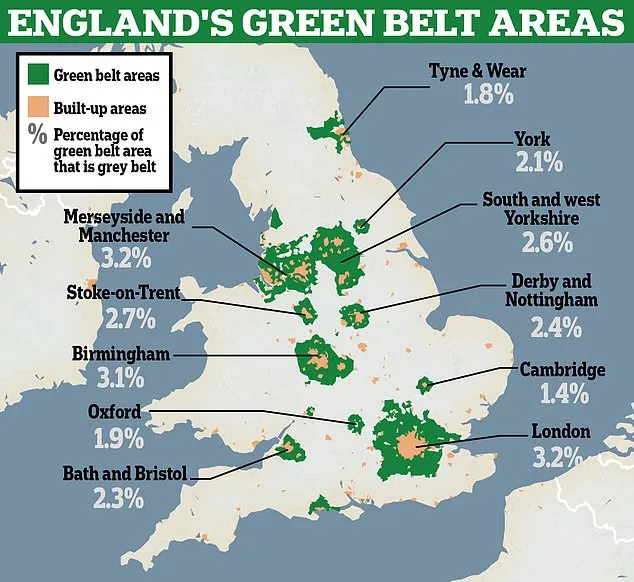 Photo: Green Belt, via i.dailymail.co.uk
The headline figure the government prefers to lead with is 1.5 million new homes over five years. It is an ambitious target, and one that virtually every serious analyst regards as unachievable under any planning framework. The Construction Industry Training Board has consistently warned that the sector simply does not have the workforce to build at that pace. But the target serves a political purpose regardless: it positions Labour as the party of action on housing, and anyone who raises awkward questions about demand as the party of obstruction.
What the Framework Actually Does
The revised NPPF places new mandatory housing targets on local authorities, restoring a system the previous Conservative government had partially softened in response to backbench pressure. Councils that fail to demonstrate a five-year housing land supply — and many cannot — will find themselves unable to refuse speculative planning applications on Green Belt or Grey Belt sites. The presumption, in planning terms, tilts decisively toward development.
Local objections, which previously carried meaningful weight in the planning process, are now systematically overridden by the national framework. Communities that have spent decades protecting their local character — the village envelope, the rural buffer, the fields that separate one town from the next — are being told by Whitehall that their preferences are subordinate to a numerical target set by ministers they did not elect and cannot remove.
This is not localism. It is the opposite of localism. It is centralised planning with a pastoral veneer.
The Question Nobody Will Answer
Here is the question that sits at the heart of this entire debate, and which the political class has spent the better part of a decade refusing to answer directly: why is housing demand so relentlessly, structurally elevated?
Net migration to the United Kingdom reached 728,000 in the year to June 2023, according to the Office for National Statistics — a figure so large it exceeds the total population of several British cities. Even as the numbers have moderated somewhat since, the cumulative effect of sustained high migration over the past decade has added millions of people to a country that was already struggling to build homes at a rate commensurate with its existing population.
The government's own household formation projections — the figures that underpin housing targets — are driven substantially by population growth. And population growth, in contemporary Britain, is driven substantially by net migration. This is not a contested claim. It is an arithmetical one. Yet ministers will discuss housing targets, planning reform, and Green Belt designation at enormous length without once engaging with the upstream driver of the demand they are trying to accommodate.
The reason is obvious. To acknowledge the immigration-housing nexus honestly would be to concede that no planning reform, however radical, can sustainably house a population growing at this pace without either building permanently on the countryside or accepting that the crisis is, in part, a consequence of deliberate policy choices on migration. Neither admission is politically comfortable.
The People Who Pay the Price
The communities bearing the cost of this evasion are not abstract. They are the residents of semi-rural market towns who have watched their village school become oversubscribed, their GP surgery impossible to get an appointment at, and their surrounding fields earmarked for a 400-home development they had no meaningful say over. They are the farmers on the urban fringe whose land value has been suddenly and artificially elevated by designation changes, creating inheritance tax complications and speculative pressure they never sought. They are the suburban homeowners who bought their properties in part because of the Green Belt boundary — a boundary they were told was sacrosanct.
Property rights matter in a conservative framework not merely as an economic abstraction but as a practical expression of the relationship between the citizen and the state. When the government can override the planning protections that gave your property its value, your neighbourhood its character, and your community its identity — without meaningful local consent — something fundamental has been violated.
The Strongest Case for Reform — and Why It Falls Short
It is only fair to acknowledge that the case for planning liberalisation is not without merit. Britain's planning system is genuinely dysfunctional. Green Belt policy has historically protected not ancient woodland and rolling farmland but, in many cases, scrubby urban-fringe land of negligible ecological value. The system has been weaponised by wealthy homeowners to prevent any development near them, regardless of social need. These are real problems.
But the answer to a broken planning system is not to hand central government a blank cheque to override local democracy in pursuit of a housing target that cannot be met regardless of how much countryside is released. The answer is genuine localisation — empowering communities to plan for genuine local need, with the flexibility to accommodate growth where it is wanted and to resist it where it is not. What Labour has delivered is the opposite: a top-down imposition dressed up as reform.
What This Signals
The broader political implication is this: a government that refuses to control the upstream driver of housing demand — net migration — while simultaneously bulldozing the countryside to accommodate that demand is not solving a crisis. It is managing its political optics at the expense of the English landscape and the communities within it.
At some point, the electorate will notice the connection that ministers are so careful to obscure. When they do, the political reckoning will be considerable.
Concreting over England's countryside to house a population boom that policy itself created is not a solution — it is a confession dressed up as a planning document.