Northern Promises, Southern Control: Why Labour's Regional Growth Agenda Is a Whitehall Illusion

The Pledge That Never Quite Arrives
Labour arrived in government last July with a familiar set of promises tucked inside its manifesto: investment in the regions, power closer to the people, a serious reckoning with the decades-long dominance of London and the South East. The language was confident. The commitments, on closer inspection, were considerably less so. More than a year into Keir Starmer's administration, the structural machinery of British economic governance remains exactly where it has always been — inside the Treasury, inside Whitehall, and inside the minds of officials who have never lived north of Watford Gap.
This is not a new failure. It is a recurring one. And the fact that Labour is repeating it, while dressing it up in the language of renewal, makes it considerably more dishonest than the versions that came before.
What 'Levelling Up' Actually Left Behind
The Conservatives' own levelling up agenda — launched with considerable fanfare under Boris Johnson — delivered mixed results at best. The Levelling Up and Regeneration Act created frameworks and missions, appointed a Secretary of State with a grand brief, and produced a White Paper of genuine ambition. But critics from across the political spectrum were right to note that funding remained heavily controlled by central government, competitive bidding processes disadvantaged councils with fewer administrative resources, and too many 'levelled up' announcements turned out to be repackaged existing commitments.
Labour, to its credit, inherited a genuine problem. To its discredit, it has chosen a solution that is largely cosmetic. The Government's Industrial Strategy, published in draft form earlier this year, concentrates its high-value sector focus on areas — advanced manufacturing corridors, life sciences clusters, creative industries — where southern England already holds structural advantages. The investment zones and growth corridors being championed by the Treasury are real, but their geography tells a story. London's financial services ecosystem continues to receive preferential regulatory treatment. The Oxford-Cambridge Arc remains a policy priority. Northern cities, by contrast, receive warm words and metro mayor photo opportunities.
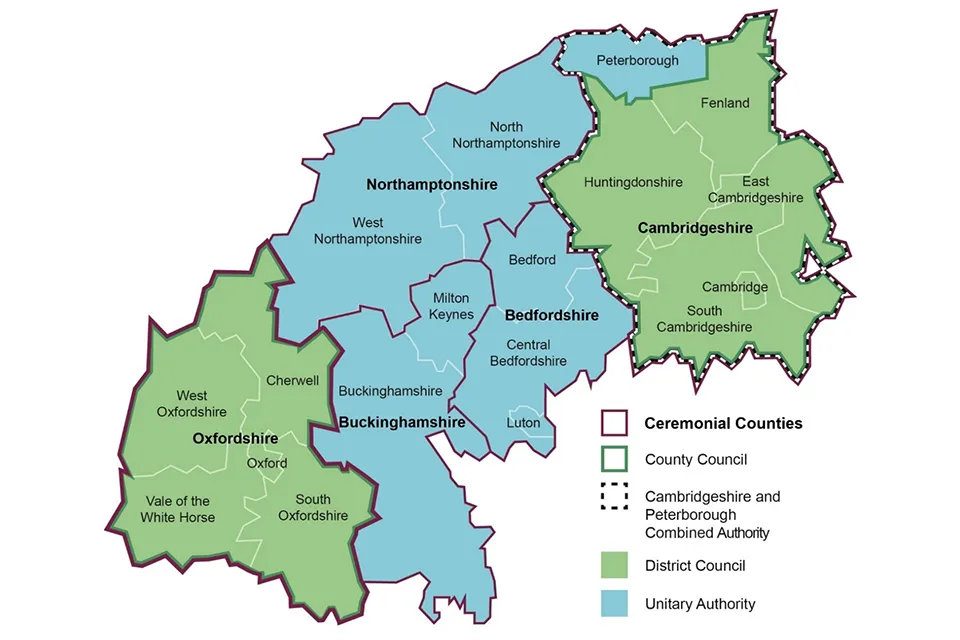 Photo: Oxford-Cambridge Arc, via assets.publishing.service.gov.uk
Metro Mayors: Power or Performance Art?
The Government's preferred mechanism for regional empowerment is the combined authority model — devolving a bundle of responsibilities to elected metro mayors covering areas like Greater Manchester, the West Yorkshire, and the North East. On paper, this looks like meaningful decentralisation. In practice, it is a carefully managed illusion.
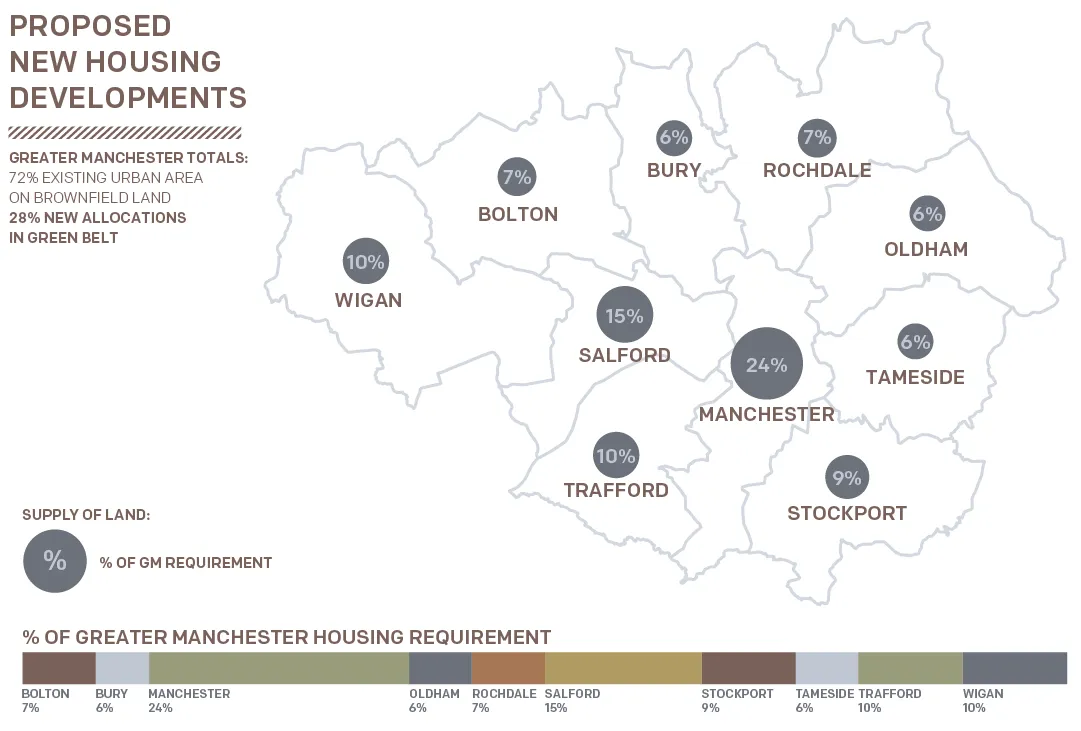 Photo: Greater Manchester, via miro.medium.com
Consider what metro mayors actually control. Transport investment requires Treasury sign-off on any significant capital expenditure. Skills funding flows through central government frameworks. Housing targets are set nationally. Economic development powers exist largely at the margins — mayors can convene, advocate, and occasionally direct small pots of funding, but they cannot set their own tax rates, issue bonds on meaningful terms, or redirect spending from national programmes that are failing their areas. When Andy Burnham in Greater Manchester or Tracy Brabin in West Yorkshire speak about their regions' needs, they are ultimately petitioning Whitehall rather than governing independently.
The contrast with genuine fiscal devolution — as practised in Germany's Länder system, or in the devolved administrations of Scotland and Wales — is stark. Those bodies raise meaningful proportions of their own revenue and are accountable to their electorates for the consequences. English metro mayors are, at best, powerful advocates and, at worst, a convenient buffer between central government failure and local frustration.
The Treasury's Iron Grip
The deeper problem is structural and will not be resolved by any particular government's goodwill. HM Treasury operates as the central nervous system of British economic policymaking, and its institutional culture is profoundly London-centric. Senior officials are disproportionately recruited from Russell Group universities, concentrated in London, and socialised into a worldview that treats the capital's economic model as the national template.
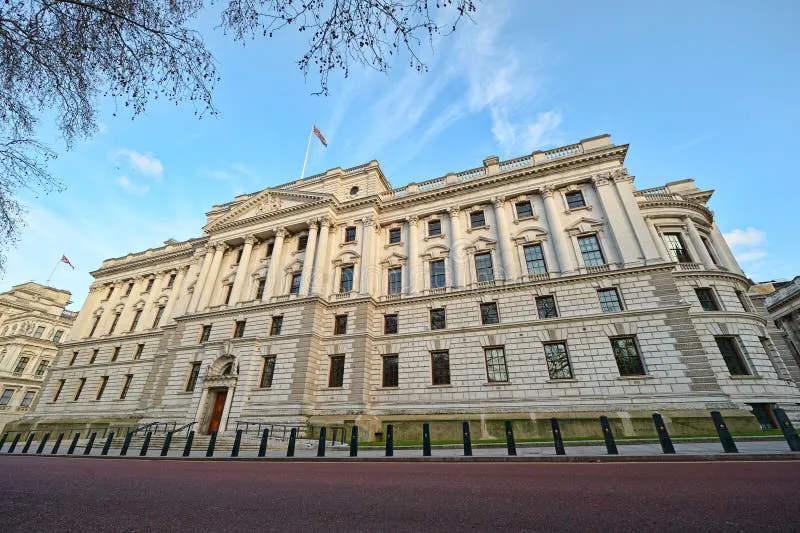 Photo: HM Treasury, via thumbs.dreamstime.com
This is not a conspiracy. It is a bias baked into the system over generations. When spending reviews are conducted, the categories that receive priority — financial services regulation, digital infrastructure in high-density urban areas, transport links that serve commuter belts into London — reflect the lived experience and analytical frameworks of those conducting them. Regional productivity data is collected, noted, and then largely subordinated to aggregate national targets that London's weight inevitably dominates.
Labour has appointed a Cabinet that is, by any measure, heavily southern in its professional formation and political base. Rachel Reeves, the Chancellor, represents a Leeds constituency but has spent her career in London's financial and political ecosystem. The Prime Minister himself is a Londoner to his core. This is not disqualifying — but it matters when the question is whether the instinctive policy reflex will be to genuinely share power or to manage northern England's expectations more smoothly than the Conservatives did.
What Genuine Devolution Would Look Like
Conservatives should be careful here not to fall into the trap of opposing devolution per se. The principled position is not that Whitehall should keep all the power — it is that power devolved should be genuine, accountable, and fiscally meaningful. English regional authorities should be able to set rates of business taxation within defined bands, retain a greater share of locally generated revenue, and issue infrastructure bonds against future returns. They should have genuine control over skills and further education budgets, with the freedom to design programmes suited to local labour markets rather than national frameworks designed for an average that fits nobody precisely.
The loudest opposition to this kind of genuine devolution comes not from the north but from the Treasury itself, which is institutionally resistant to any arrangement that reduces its control over public spending flows. Labour, which depends on a large and well-resourced central state to deliver its policy programme, has no ideological incentive to weaken that control. The result is devolution in name only — mayors without money, regions without revenue, and a north-south divide that persists beneath a layer of sympathetic press releases.
What This Means at the Ballot Box
The political consequences of this failure will take time to materialise, but they are coming. Northern England's working-class vote shifted meaningfully toward the Conservatives under Boris Johnson in 2019 — not because those voters suddenly became Thatcherites, but because they sensed that the metropolitan liberal establishment, including Labour's own leadership, had stopped listening to them. Labour won many of those seats back in 2024 on the back of Conservative collapse rather than genuine reconnection.
If the next five years produce another cycle of warm rhetoric and centralised control, that recapture will prove temporary. The voters of Leigh, Wakefield, and Hartlepool are not naive. They know the difference between a government that is governing for them and one that is managing them. Labour would do well to learn it too — before the next election makes the lesson unavoidable.
Talking northern while governing metropolitan is not a regional growth strategy; it is a confidence trick, and Britain's north deserves considerably better.